绘本故事《Winnie the Pooh’s 1,2,3 (Winnie-The-Pooh Collection)》- 适合
绘本《Winnie the Pooh’s 1,2,3 (Winnie-The-Pooh Collection)》,Dutton Children’s Books
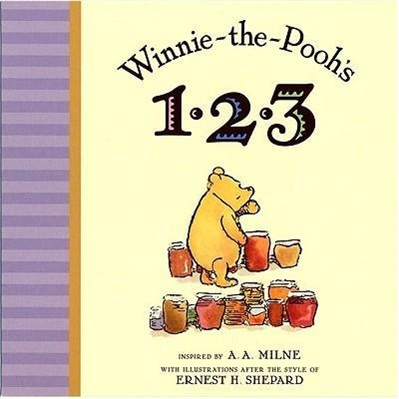
绘本内容
With Tigger as their guide, children will relish an adventure featuring letters, numbers, animals, shapes, opposites, and more on pages packed with surprises hidden under fun fl aps. This is an primer to learning fun that children will want to join again and again!
A. A. Milne A. A. Milne may not have intended to become a children’s book author, but his greatest creation, the honey-loving bear Winnie the Pooh, is so much a part of the culture that one can scarcely imagine children’s literature without him. Milne created Pooh to entertain his son, Christopher, which he did – and millions of other readers as well. Biography It seems strange that A. A. Milne would have not have wanted to be associated with one of literature’s most beloved characters. Having achieved some success as a playwright and novelist, he aspired to be more than only an author of children’s books. However, Milne’s books — Winnie-the-Pooh, The House at Pooh Corner, and the verse collections When We Were Very Young and Now We Are Six — are hardly typical of most stories for kids. They remain among the smartest of the genre, and were likely written as much for himself as for his young son, Christopher. Infused with a sly wit, they contain humor that only an adult can appreciate; indeed, some of the poems in When We Were Very Young first appeared in the satiric magazine Punch, where Milne was an editor. Rendered by illustrator Ernest H. Shepard in quaint, warm watercolors, Pooh and friends Tigger, Kanga, Roo, Owl, Eeyore, and Piglet star in stories about playing games and helping friends in and around their home near “100-Aker Wood.” In one instance of Milne’s ironic humor, a sign outside Owl’s residence reading “PLES RING IF AN RNSER IS REQIRD” is attributed to Pooh’s boy companion Christoper Robin, “who was the only one in the forest who could spell.” The books are written with sophistication and a certain amount of dry British wit, employing turns of phrase (“customary procedure,” “general remarks”) not usually found in children’s stories. The volumes of verse range over a wider collection of themes, with Pooh appearing in just a few poems. Most of them offer a young person’s perspective on subjects such as imaginary friends, feigning illness, and going to the zoo; and it’s evident how Milne’s work prefigures that of Dr. Seuss (From Going to the Zoo: “There are biffalo-buffalo-bisons/A great big bear with wings/There’s sort of a tiny potamus/A tiny nossarus too”). Other poems feature cowardly knights, buffoonish Sirs, and other fantasy figures. Little of Milne’s work for adults, which included the autobiography Year In, Year Out and his first novel, Lovers in London, can be easily found in print. One adult title, however, is still being published: the pleasing Gosford Park-style Red House Mystery. Pooh, meanwhile, continues to grow as a powerful franchise, with modern-day titles, animation, and games that are almost as delightful as Milne’s original texts — but not quite. Good To Know Milne did not set out with any particular desire to write for children: The Pooh books were originally intended for the real Christopher Robin, Milne’s son. Milne’s teacher and mentor was the scientist and writer H.G. Wells. He edited Cambridge’s undergrad paper, Granta, and was later the assistant editor of Punch. Milne wrote several plays that are no longer published, but were once quite popular, including as Mr. Pim Passes By and the Kenneth Grahame adaptation Toad of Toad Hall. Also Known As: Alan Alexander Hometown: Cotchford Farm, Sussex, England Date of Birth: 一月 18, 1882 Place of Birth: Hampstead, London Date of Death: 1311956 Place of Death: Cotchford Farm, Sussex, England